
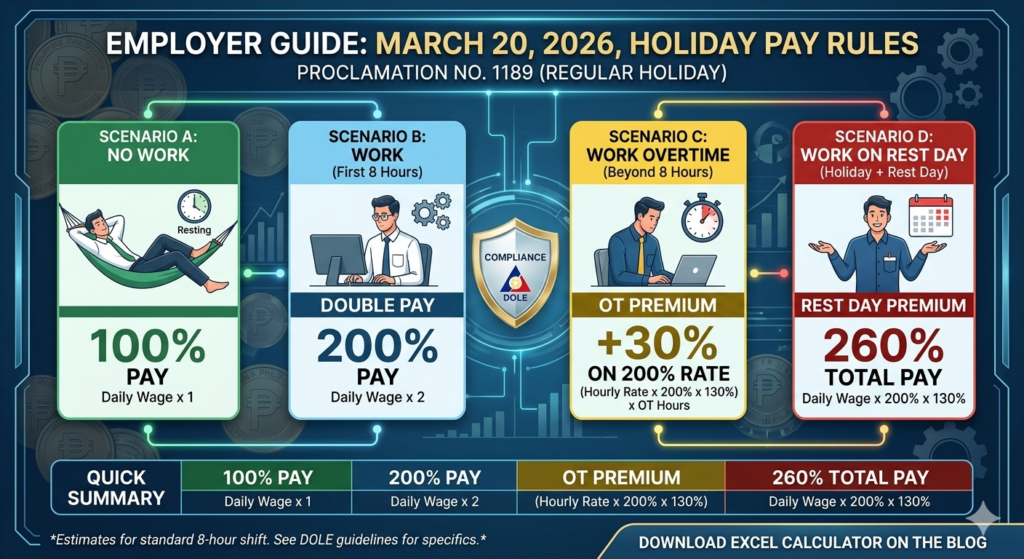
With the recent signing of Proclamation No. 1189, s. 2026, Malacañang has officially designated Friday, March 20, 2026, as a Regular Holiday for Eid’l Fitr.
For employers and payroll managers, this means specific legal obligations under the Labor Code. Unlike “Special Non-Working Days,” a Regular Holiday requires a higher compensation tier. Below is the definitive guide to computing wages for the upcoming long weekend.
1. The “Workday Prior” Rule
To be entitled to holiday pay, an employee must have been present or on leave with pay on the workday immediately preceding the holiday.
- The Scenario: Since March 20 is a Friday, the “workday prior” is Thursday, March 19.
- The Rule: If an employee is on unpaid leave on March 19, the employer is not legally required to pay the 100% holiday rate if they do not work on March 20.
2. Holiday Pay Computations
As a Regular Holiday, the following DOLE formulas apply for an 8-hour shift:
Scenario A: Employee Does Not Work
The employee receives 100% of their basic daily wage.
Formula: $Daily Wage \times 100\%$
Example: If the wage is ₱700, they receive ₱700 even while resting at home.
Scenario B: Employee Works (First 8 Hours)
The employee is entitled to double pay or 200% of their basic wage.
Formula: $Daily Wage \times 200\%$
Example: ₱700 wage becomes ₱1,400 for the day.
Scenario C: Employee Works Overtime
For work exceeding 8 hours, an additional 30% of the hourly rate on said day is added.
Formula: $(Hourly Rate \times 200\% \times 130\%) \times OT Hours$
Scenario D: Holiday Falls on a Rest Day
If March 20 is the employee’s scheduled rest day but they are required to work, they receive an additional 30% on top of the 200% rate.
Formula: $Daily Wage \times 200\% \times 130\% = 260\%$
Example: ₱700 wage becomes ₱1,820 for the day.
Quick Summary Table
| Work Status | Pay Rate |
| No Work | 100% |
| Work (First 8 Hours) | 200% |
| Overtime (Beyond 8 Hours) | Hourly Rate x 260% |
| Work on Rest Day | 260% |