Updated August 26, 2026 with Day 14–18 trial developments.
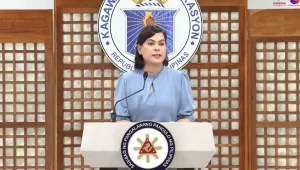
Vice President Sara Duterte is the first Philippine official to be impeached twice — and is now on trial before the Senate for the second time, after her first impeachment was struck down by the Supreme Court. Here’s the full, sourced timeline of how the case got here, and where it stands now.
Note: This is a developing legal and political story. The claims below are allegations under formal proceedings — Duterte has not been convicted of any charge, and her defense team disputes the prosecution’s case. This article will be updated as the trial continues.
🏛️ Basahin sa Tagalog: Impeachment Trial ni VP Sara Duterte: Simpleng Paliwanag sa Kaso
QUICK SUMMARY
| Who | Vice President Sara Duterte |
| What | Second impeachment trial, ongoing before the Senate impeachment court |
| Articles of Impeachment | 4 (confidential funds misuse, unexplained wealth/SALN violations, bribery/procurement irregularities, alleged assassination threats) |
| First impeached | February 5, 2025 — later voided by the Supreme Court |
| Second impeached | May 11, 2026 |
| Trial began | July 6, 2026 |
| Presiding officer | Sen. Francis “Chiz” Escudero (elected by the impeachment court, not the sitting Senate President) |
| Lead prosecutor | Rep. Gerville Luistro |
| Conviction threshold | Two-thirds vote of all senator-judges (16 of 24) |
| Possible penalty if convicted | Removal from office and perpetual disqualification from public office |
| Expected conclusion | Escudero said Aug. 25 he’s optimistic the trial will wrap up by the end of 2026 |
FULL TIMELINE
The First Impeachment (2024–2025)
December 2–19, 2024 — Three separate impeachment complaints are filed against Duterte before the House of Representatives by private individuals and groups, citing the alleged misuse of confidential funds and a November 2024 press conference in which Duterte discussed a threat against President Ferdinand Marcos Jr., First Lady Liza Araneta-Marcos, and then-Speaker Martin Romualdez.
February 5, 2025 — The House impeaches Duterte through a fast-track process, with 215 members voting in favor. The complaint is transmitted to the Senate.
June 10, 2025 — The Senate convenes as an impeachment court but votes to remand the articles back to the House pending questions about their constitutionality.
July 25, 2025 — The Supreme Court, voting 13-0 with two justices not participating, declares the Articles of Impeachment unconstitutional, citing a violation of the Constitution’s one-year bar rule and a due-process violation. The Court explicitly notes its ruling does not absolve Duterte of the underlying allegations — only that this particular process was constitutionally flawed.
August 6, 2025 — The Senate votes 19-4 to archive the impeachment case.
The Second Impeachment (2026)
January–February 2026 — New impeachment complaints begin circulating, including one that cites an affidavit from Ramil Madriaga, identified as a former aide to Duterte who described himself as her “bagman.”
February 23, 2026 — Four new complaints are formally referred to the House Committee on Justice.
April 29, 2026 — The House Committee on Justice votes 53-0 to find probable cause, consolidating the complaints into a single set of four Articles of Impeachment.
May 11, 2026 — The House votes 257-25 to impeach Duterte for a second time, making her the first Philippine official impeached twice.
May 18, 2026 — The Senate convenes as an impeachment court, with Senate President Sherwin Gatchalian presiding.
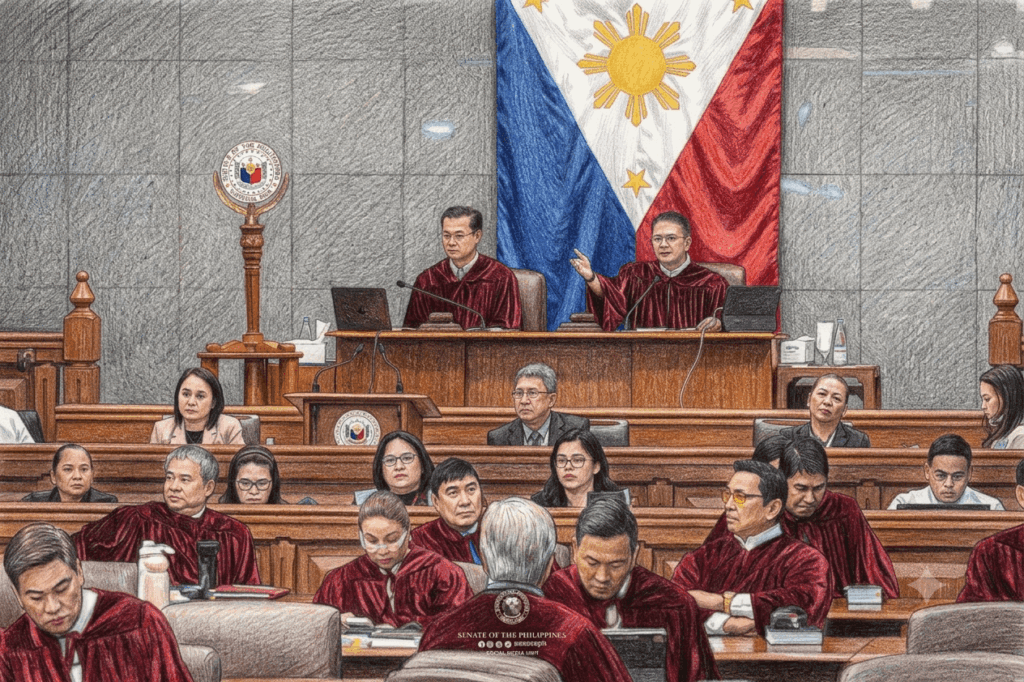
July 6, 2026 — The trial proper begins. The court elects Sen. Francis “Chiz” Escudero, 12-8, as presiding officer under a Senate rule amended on June 3, 2026 — over objections from the Cayetano-led minority bloc. Escudero runs day-to-day proceedings going forward, while Gatchalian retains the Senate presidency. The Senate approves 92 trial days.
July 20, 2026 (Day 7) — The impeachment court grants subpoenas for Duterte’s and her husband Manases Carpio’s bank, AMLC, and tax records.
July 29, 2026 (Day 10) — The prosecution begins presenting evidence under Article I, covering the alleged confidential funds misuse.
August 3–5, 2026 (Days 11–13) — Prosecution submits Commission on Audit (COA) documents on the alleged misuse of ₱612.5 million in confidential funds, including ₱125 million released to the Office of the Vice President (OVP) and disbursed within 11 days in December 2022, according to COA records the defense declined to stipulate to. COA auditor Roderick Wamil testifies that ₱500,000 in furniture and ₱3 million in computers/printers purchased with confidential funds lacked documentation tying them to confidential operations. On August 5, the Supreme Court En Banc dismisses consolidated petitions seeking to halt the trial, ruling them moot.
August 10, 2026 — Trial proceedings are postponed after heavy rains and flooding in Metro Manila prompt a government-wide shift to work-from-home arrangements.
August 11, 2026 (Day 14) — Duterte’s legal camp argues she cannot be criminally prosecuted for grave threats while the impeachment trial is ongoing, since the criminal charge covers allegations also part of the impeachment case. Separately, impeachment court spokesperson Regie Tongol declines to characterize senator-judges’ absences from proceedings, saying it’s up to each senator to explain their own attendance. Senator-Judge Juan Miguel “Migz” Zubiri asks to move sessions to the afternoon to give both sides more time to argue evidence without interruption.
August 17, 2026 — Former OVP Special Disbursing Officer Gina Acosta, testifying under direct examination, says she released ₱500 million in confidential funds in 2022–2023 to Colonel Raymund Lachica — the OVP’s former security officer — on Duterte’s orders, despite guidelines that reportedly don’t permit this arrangement. The impeachment court subsequently declares Acosta a hostile witness. Separately, Malacañang says it cannot confirm reports that Duterte sought a “private meeting” with President Marcos.
August 24, 2026 (Day 17) — Testimony continues regarding the ₱500 million disbursed to Col. Lachica between 2022 and 2023. The House prosecution panel says it remains undecided on whether to call Lachica himself as a hostile witness, weighing the risk of unreliable testimony against statements already made under oath. The defense declines to disclose its planned witnesses or strategy. Sen. Erwin Tulfo questions Acosta about a reported ₱122 million in medicines purchased with confidential funds, characterized as “rewards for informants.”
August 25, 2026 (Day 18) — Presiding Officer Escudero tells Senator-Judge Zubiri he’s optimistic the trial will conclude by the end of 2026, factoring in the Senate’s upcoming work on the 2027 national budget. The House prosecution panel says it isn’t concerned about Col. Lachica’s potential testimony if the defense calls him as a witness. OVP Assistant Secretary Lemuel Ortonio testifies that Duterte was knowledgeable about how the ₱500 million in OVP confidential funds was spent.
August 26, 2026 (Day 18, continued) — Ortonio, testifying as a hostile witness given his tenure was co-terminus with Duterte’s, says the OVP requested ₱250 million in confidential funds in August 2022 and submitted its spending plan roughly a month later. He testifies that Duterte was aware of and had authorized the fund’s handling, from disbursement through liquidation, and was informed of related audit findings.
THE FOUR ARTICLES OF IMPEACHMENT
- Article I: Alleged misuse of ₱612.5 million in confidential funds — ₱500 million from the Office of the Vice President and ₱112.5 million from the Department of Education during Duterte’s tenure as education secretary.
- Article II: Alleged unexplained wealth and failure to truthfully disclose assets in her SALNs from 2022 to 2024, along with an alleged failure to divest business interests.
- Article III: Alleged bribery and procurement irregularities involving Department of Education officials.
- Article IV: Alleged assassination threats against President Marcos, First Lady Liza Araneta-Marcos, and former Speaker Martin Romualdez, tied to Duterte’s November 2024 public statements.
WHO’S INVOLVED
- Presiding officer: Sen. Francis “Chiz” Escudero
- Senate President (sitting): Sherwin “Win” Gatchalian
- House prosecution panel: Led by Rep. Gerville Luistro, with private prosecutors including Lorna Kapunan, Mae Divinagracia, and Benjamin Tolosa Jr. as panel spokesperson
- Defense counsel: Litigator Sheila Sison and Michael Poa, leading Duterte’s legal team
- Impeachment court spokesperson: Regie Tongol
- Senator-judges: All 24 members of the Senate sit as judges; conviction on any article requires at least 16 votes
FAQS
Her first impeachment (February 2025) was struck down by the Supreme Court in July 2025 for violating the constitutional one-year bar rule and due-process protections. A second, separately filed set of complaints led to her second impeachment in May 2026.
No. The Court’s 2025 ruling addressed only the constitutionality of the process used, and explicitly stated it was not absolving Duterte of the underlying allegations.
Conviction on any single article requires a two-thirds vote of the Senate (16 of 24 senator-judges) and would result in removal from office and permanent disqualification from holding public office.
Yes, as of this writing. The Senate has allotted up to 92 trial days, and proceedings are continuing through witness testimony and evidence presentation on Article I.
THE BOTTOM LINE
Sara Duterte’s impeachment saga has already run through a full House vote, a Senate remand, a Supreme Court reversal, and a second full impeachment process. As of Day 18, the Senate trial is deep into witness testimony on the confidential funds allegations (Article I), with the presiding officer now signaling a possible end-of-year conclusion. We’ll keep this timeline updated as the case develops.
This is a living article — we will update the timeline as new trial days, rulings, or developments occur. Given the sensitivity and legal stakes of this case, all claims are attributed to the relevant proceedings and should not be read as a determination of guilt or innocence.
SOURCES / FOOTNOTES
- Supreme Court of the Philippines, “SC: House impeachment complaint vs VP Duterte barred by 1-year rule…”.
- Philippine News Agency, “House impeaches VP Sara Duterte with 257 votes”.
- Philippine Daily Inquirer, “Impeached anew: House OKs articles vs Sara Duterte again with 257 votes”, May 2026.
- GMA News Online, “LIVE UPDATES: Sara Duterte Impeachment Trial (August 3, 2026)”.
- GMA News Online, “LIVE UPDATES: Sara Duterte Impeachment Trial (August 4, 2026)”.
- GMA News Online, “LIVE UPDATES: Sara Duterte Impeachment Trial (August 11, 2026)”.
- GMA News Online, “LIVE UPDATES: Sara Duterte Impeachment Trial (August 17, 2026)”.
- GMA News Online, “LIVE UPDATES: Sara Duterte Impeachment Trial (August 24, 2026)”.
- GMA News Online, “LIVE UPDATES: Sara Duterte Impeachment Trial (August 25, 2026)”.
- GMA News Online, “LIVE UPDATES: Sara Duterte Impeachment Trial (August 26, 2026)”.
- Rappler, “Chiz Escudero elected as presiding officer in Sara Duterte’s impeachment trial”, July 2026.
- Wikipedia, “Impeachment trial of Sara Duterte”.