Pax Silica is a US-led coalition aiming to secure the world’s AI and semiconductor supply chains — and the Philippines has staked out a central role in it, with a proposed 1,620-hectare industrial hub planned for New Clark City, Tarlac. Here’s what it actually is, how it works, and why it’s become one of the most talked-about infrastructure debates of 2026.
Curious what people are actually saying about it? See our companion piece: Pax Silica’s Philippine Debate Has Moved From Technology Promise to a Test of Public Trust, based on 5.89 million tracked Facebook reactions.
QUICK FACTS
| What it is | A US-led coalition securing supply chains for AI, semiconductors, and critical minerals |
| Formal launch | December 12, 2025 (Pax Silica Summit, Washington, DC) |
| Philippines joined | April 2026, as the 13th member |
| Coalition size (Aug 2026) | More than 30 participating countries |
| Proposed PH site | New Clark City, Tarlac — approx. 1,618–1,620 hectares |
| Lead PH agency | Bases Conversion and Development Authority (BCDA) |
| Site designation | “Golden Node” — first Coordination Office of its kind under Pax Silica |
| Anchor tenant | Foxconn |
| Projected investment | US$40–70 billion |
| Projected jobs | Up to 190,000 |
| First-phase development | ~500 hectares, expected to begin within 3–5 years |
| Framework agreement | Draft finalized; signing targeted for November 2026 |
WHAT IS PAX SILICA?
Pax Silica is an international coalition, led by the United States, built around a straightforward strategic goal: securing a “trusted” global supply chain for the technologies that increasingly underpin modern economies — artificial intelligence, semiconductors, critical minerals, and advanced manufacturing. The initiative was formally convened on December 12, 2025, when US Undersecretary of State for Economic Affairs Jacob Helberg brought together a high-level private gathering focused on economic security at the Donald J. Trump Institute of Peace in Washington, DC.
The idea, in Helberg’s own framing, isn’t to recreate 20th-century factory models but to build what he calls “AI-native” manufacturing ecosystems from the ground up — anchored in the rule of law and integrated into a network of countries the US considers trustworthy partners for supply chain resilience.
The Philippines joined in April 2026 as the coalition’s 13th member. Membership has grown quickly since — to 23 countries by mid-July and past 30 by August, according to Philippine government sources — reflecting how quickly this framework has expanded beyond its founding members.
WHY NEW CLARK CITY?
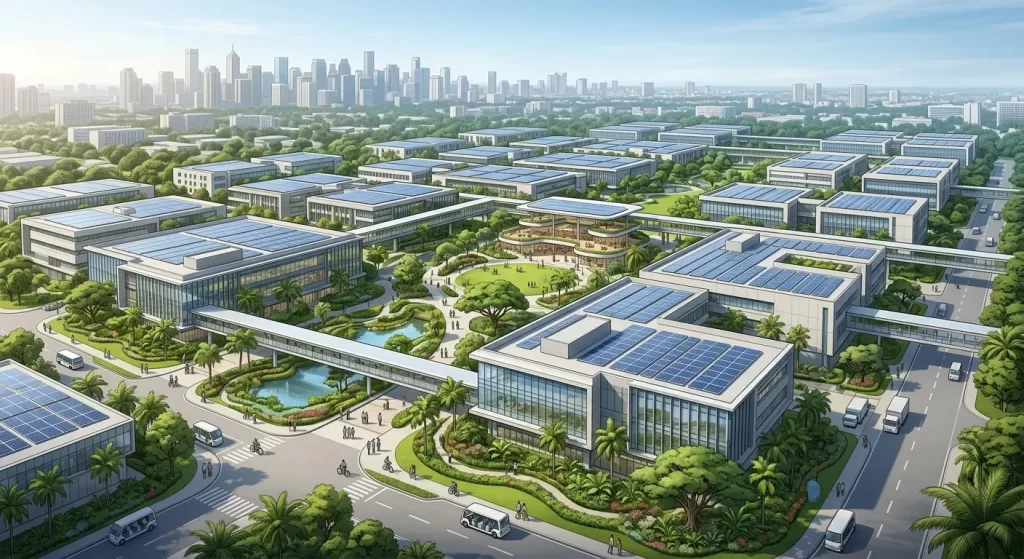
The Philippine component of Pax Silica centers on a proposed 1,618–1,620 hectare site within New Clark City, Tarlac — a planned metropolis the Bases Conversion and Development Authority has been developing since well before Pax Silica existed, originally envisioned as the country’s first smart, disaster-resilient, green city.
That existing groundwork is a big part of the pitch: New Clark City already has some infrastructure in place (a National Government Administrative Center, sports facilities, and ongoing road, school, and utility development), sits within the broader Luzon Economic Corridor, and is close to Clark International Airport and major expressways — all factors BCDA argues make it well-positioned to host an AI-native industrial cluster.
The site has been designated a “Golden Node,” hosting the first Coordination Office established anywhere under the Pax Silica framework — a marker of how central the Philippine site is meant to be within the broader coalition, at least symbolically.
THE NUMBERS BEHIND THE PITCH
BCDA has floated some genuinely large figures for what Pax Silica could mean economically:
- US$40–70 billion in projected investment once the site is fully developed
- Up to 190,000 high-quality jobs for Filipino engineers, researchers, computer science graduates, and other skilled professionals
- Roughly US$200 billion in projected Philippine exports once the project reaches full operation, on a roughly 30-year horizon
- Foxconn, the Taiwanese manufacturing giant responsible for an estimated 40% of the world’s consumer electronics, has been identified as the anchor tenant for the first Pax Silica technology hub
Development itself is expected to move in phases: BCDA President and CEO Joshua Bingcang has said the first phase, covering roughly 500 of the site’s 1,620 hectares, is expected to begin within three to five years — meaning the headline investment and jobs figures represent a long-term outcome, not an immediate one.
WHAT’S ACTUALLY IN DISPUTE
Coverage and public discussion of Pax Silica shifted noticeably over the course of 2026 — from an initial framing centered on investment and job creation toward a set of harder, more specific questions. According to Capstone-Intel’s own social listening research, this shift is measurable: attention on Facebook rose sharply once the conversation moved from general promise toward concrete questions about land use, water and electricity demand, affected communities, consultation processes, environmental safeguards, and national sovereignty.
A few specific concerns that have surfaced in mainstream reporting:
- Resource use: Semiconductor fabrication generates hazardous waste, and the AI-related facilities on-site would require meaningful water and electricity. Critics have raised concerns about pressure on local water and energy systems, and about emissions if LNG or coal continue to factor into the site’s power mix.
- Data center scope: Earlier reporting characterized Pax Silica as an energy-intensive project centered on data centers, which BCDA’s Bingcang has since pushed back on — clarifying that any data centers built on-site would serve the semiconductor firms located there, not function as hyperscale facilities serving global cloud clients.
- Sovereignty and oversight: Some commentary and legislative voices have called for Senate scrutiny of the Pax Silica framework agreement before it moves forward, reflecting broader questions about how much control and long-term benefit the Philippines retains within a coalition led by another country.
- Community impact and consultation: Questions have also centered on how communities near New Clark City are being consulted, and what safeguards exist for those most directly affected by development.
None of this amounts to a settled verdict either way — the point, as Capstone-Intel’s own report puts it, isn’t to take a position for or against Pax Silica, but to track how the conversation is actually evolving and where the information gaps sit.
Want the full dated sequence of events? See our companion piece: Pax Silica Timeline: From Announcement to Public Debate.
FAQS
What is Pax Silica? A US-led international coalition focused on securing supply chains for AI, semiconductors, and critical minerals among trusted partner countries.
When did the Philippines join? April 2026, as the coalition’s 13th member.
Where will the Philippine hub be located? New Clark City, Tarlac, on a proposed site of roughly 1,618–1,620 hectares.
Who is funding or building it? Pax Silica draws investment from coalition member countries and private companies; Foxconn has been named as the first anchor tenant. The Bases Conversion and Development Authority leads the project on the Philippine side.
When will it actually be built? BCDA expects the first development phase (~500 hectares) to begin within three to five years, with full operations unfolding over roughly 30 years.
Is this project controversial? It’s generated substantial public debate, particularly around resource use, sovereignty, and community consultation — though the project itself is still in a framework and early-planning stage, with a formal agreement not yet signed as of this writing.
This is a living explainer — we’ll update it as the framework agreement, coalition membership, and site development progress.
Continue exploring our Pax Silica coverage: Pax Silica Timeline: From Announcement to Public Debate · Pax Silica’s Philippine Debate Has Moved From Technology Promise to a Test of Public Trust · Land, Displacement, and Pax Silica: Tracking Community Concerns Online · Pax Silica and Water Security: What the Facebook Conversation Reveals
SOURCES
- Philippine News Agency, “New Clark City to host AI hub under US-led Pax Silica”, April 2026.
- Philippine News Agency, “Pax Silica hub to boost PH role in global AI value chain”.
- Philippine News Agency, “Pax Silica AI hub to start development in 3-5 years”.
- Bases Conversion and Development Authority, “New Clark City to serve as AI hub under US-led Pax Silica Initiative”.
- BusinessWorld Online, “PHL, US finalize draft for Pax Silica AI hub framework”, July 2026.
- Philippine Daily Inquirer, “Pax Silica brings promise – but at what cost?”.
- Philippine Daily Inquirer, “Pax Silica site development eyed in 3 to 5 years”.
- Rappler, “Vantage Point: Pax Silica, America’s blueprint for the AI economy”.
- Capstone-Intel, “Pax Silica’s Philippine Debate Has Moved From Technology Promise to a Test of Public Trust”, August 2026.