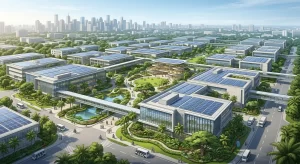
In under a year, Pax Silica went from a closed-door summit in Washington to a full-blown public debate on Philippine Facebook, with 5.89 million reactions logged by Capstone-Intel’s own social listening research. Here’s the complete, dated timeline of how it got there.
New to Pax Silica? Start with our explainer on what the AI industrial hub actually is for the background before diving into the timeline.
QUICK SUMMARY
| What | A US-led coalition to secure AI/semiconductor/critical-mineral supply chains, with a proposed 1,618–1,620 hectare hub in New Clark City, Tarlac |
| Philippines joined | April 2026, as the coalition’s 13th member |
| Coalition size (as of Aug 2026) | More than 30 participating countries |
| Lead agency (PH side) | Bases Conversion and Development Authority (BCDA) |
| Anchor tenant announced | Foxconn |
| Framework agreement | Draft finalized July 2026; signing targeted for November 2026 |
| Site development timeline | First phase (~500 hectares) expected to begin in 3–5 years |
| Projected investment | US$40–70 billion |
| Projected jobs | Up to 190,000 |
FULL TIMELINE
December 12, 2025 — US Undersecretary of State for Economic Affairs Jacob Helberg convenes the first Pax Silica Summit, a high-level private gathering on economic security, at the Donald J. Trump Institute of Peace in Washington, DC — the initiative’s formal starting point.
April 2026 — The Philippines formally joins the Pax Silica Declaration as the coalition’s 13th member. Finance Secretary Frederick Go frames the move as ensuring the country’s mineral resources and strategic location are “actively harnessed to build the industries of the future” rather than merely supporting global industries from the margins. New Clark City in Tarlac, on a roughly 1,618-hectare property, is named to host the hub’s Coordination Office — designated a “Golden Node,” described by Helberg as a new model for AI-native investment acceleration.
Through mid-2026 — The Pax Silica coalition grows quickly, expanding from 13 founding-era members to 23 by mid-July and more than 30 by August, according to BCDA and Philippine News Agency reporting.
July 4, 2026 — In one of the earlier signs of local community engagement, BCDA brings together nearly 100 youths from communities surrounding New Clark City for a sports-and-tourism event, part of the agency’s broader effort to build local buy-in around the site.
July 16, 2026 — BusinessWorld reports the Philippines and United States are finalizing a draft framework agreement to govern the AI-native hub, with a signing targeted for November 2026. BCDA President and CEO Joshua Bingcang confirms the coalition has grown to 23 member countries by this point.
July 23, 2026 — A briefing at Malacañang presents the proposed Pax Silica site plan for New Clark City to officials and stakeholders.
July 27, 2026 — President Marcos highlights Pax Silica as a strategic component of the Luzon Economic Corridor in his fifth State of the Nation Address. The same week, Inquirer publishes an aerial view of the proposed 1,620-hectare site and a widely shared analysis piece — “Pax Silica brings promise – but at what cost?” — that explicitly weighs the initiative’s economic upside against risks to water and energy systems, environmental contamination, and unequal distribution of costs and benefits. This marks a visible turn in mainstream coverage toward risk-and-accountability framing, alongside the investment-promise narrative.
Late July–August 2026 — BCDA and the Subic Bay Metropolitan Authority (SBMA) sign a partnership agreement designating the Port of Subic Bay as Pax Silica’s preferred maritime gateway, while reporting continues to note Foxconn’s role as the anchor tenant for the first Pax Silica technology hub — a shift Rappler’s Vantage Point newsletter frames as a systemic realignment of global tech supply chains rather than a routine FDI announcement.
Early August 2026 — BCDA’s Bingcang publicly clarifies that Pax Silica’s data centers, if built, are intended to serve on-site semiconductor firms rather than hyperscale or global cloud clients, pushing back on earlier reporting that characterized the project as energy-intensive on the scale of major data-center campuses. He confirms site development is expected to begin within three to five years, with the first phase covering roughly 500 of the site’s 1,620 hectares, and full operations projected over a 30-year horizon aimed at lifting Philippine exports toward US$200 billion.
Same period — Separate reporting raises calls for Senate scrutiny of the Pax Silica framework before it proceeds further, reflecting growing legislative and public interest in oversight of the deal’s terms.
February 2 – August 10, 2026 — Capstone-Intel’s own Facebook listening research tracks the online conversation across this entire window, recording 5,208 posts from 1,214 sources, generating 5.89 million reactions and more than 1.42 million comments and shares. The research finds that attention rose sharply once the initiative became linked to concrete questions about land, water, electricity, affected communities, consultation, and national control — mirroring the same shift visible in mainstream press coverage around the same period.
Read the full data behind this shift: Pax Silica’s Philippine Debate Has Moved From Technology Promise to a Test of Public Trust — our companion social listening report covering this exact timeframe.
August 12–13, 2026 — Capstone-Intel publishes and updates its social listening report, formalizing the “technology promise to public trust” framing that this timeline traces chronologically.
WHAT THE TIMELINE SHOWS
Laid out chronologically, two overlapping stories emerge:
- The official project timeline moves steadily but slowly — a 2025 summit, a 2026 declaration signing, a Golden Node designation, a draft framework, and a site-development horizon still measured in years, not months.
- The public conversation timeline moves much faster in the other direction — starting as investment-promise coverage in April, and pivoting sharply by late June through August toward land, water, sovereignty, and accountability questions, a shift documented in real time by Capstone-Intel’s Facebook data and mirrored in outlets like Inquirer’s late-July risk analysis.
The gap between these two speeds — a multi-year infrastructure rollout paired with a rapidly evolving public trust conversation — is arguably the central tension defining Pax Silica’s Philippine chapter so far.
FAQS
April 2026, as the coalition’s 13th member.
New Clark City, Tarlac, on a proposed 1,618–1,620 hectare site within the Luzon Economic Corridor.
Foxconn has been publicly identified as the first major tenant for the initial Pax Silica technology hub.
BCDA has said site development for the first phase (~500 hectares) is expected to start within three to five years, with full operations projected over roughly 30 years.
Capstone-Intel’s Facebook listening data shows attention rising sharply once the conversation moved from general investment promise toward specific questions about land, water, electricity, community impact, and national control — a shift also visible in mainstream press coverage from late July onward.
This is a living timeline — we’ll continue updating it as the framework agreement, site development, and public conversation progress.
🔍 Continue exploring our Pax Silica coverage: What Pax Silica Actually Is: An Explainer · Pax Silica’s Philippine Debate Has Moved From Technology Promise to a Test of Public Trust · Land, Displacement, and Pax Silica: Tracking Community Concerns Online · Pax Silica and Water Security: What the Facebook Conversation Reveals
SOURCES
- Philippine News Agency, “New Clark City to host AI hub under US-led Pax Silica”, April 2026.
- Philippine News Agency, “Pax Silica hub to boost PH role in global AI value chain”.
- Philippine News Agency, “Pax Silica AI hub to start development in 3-5 years”.
- Bases Conversion and Development Authority, “New Clark City to serve as AI hub under US-led Pax Silica Initiative”.
- BusinessWorld Online, “PHL, US finalize draft for Pax Silica AI hub framework”, July 2026.
- Philippine Daily Inquirer, “Pax Silica brings promise – but at what cost?”.
- Philippine Daily Inquirer, “Pax Silica site development eyed in 3 to 5 years”.
- Rappler, “Vantage Point: Pax Silica, America’s blueprint for the AI economy”.
- Capstone-Intel, “Pax Silica’s Philippine Debate Has Moved From Technology Promise to a Test of Public Trust”, August 2026.