Concerns about Pax Silica’s water demand got loud enough online that Malacañang publicly sought clarification from the country’s water regulator. Here’s what’s driving the water-security debate, what the numbers actually say, and where the disagreement stands.
New to Pax Silica? Start with our explainer on what the AI industrial hub actually is before diving into this specific thread.
Updated August 18, 2026 with primary data from the Capstone SIGMA Research Brief (Feb 2–Aug 10, 2026 Facebook dataset).
QUICK SUMMARY
| Main water source | Sacobia watershed, New Clark City’s primary supply |
| Watershed status | Reportedly showing signs of strain since 2020, per environmental advocates |
| Projected water demand (Inquirer analysis) | ~130 million liters/day |
| Projected water demand (separate BusinessWorld/Inquirer review) | ~39 billion liters annually (~107 million liters/day average) |
| Proposed reservoir capacity | 65–120 million liters/day |
| Potential seasonal deficit | Up to 10 million liters/day, per the same Inquirer analysis |
| Power demand | 3 gigawatts — about 16% of Luzon’s current grid capacity |
| Comparable scale | Water use compared to ~600,000 households; power output compared to three coal plants or one nuclear facility |
| Government response | Malacañang sought clarification from the National Water Resources Board (NWRB) after concerns spread on social media |
| NWRB’s position | Local water sources are sufficient; community needs will remain the priority |
HOW THIS BECAME A SOCIAL MEDIA STORY
Capstone-Intel’s own social listening research on Pax Silica tracked 5,208 Facebook posts from 1,214 sources between February 2 and August 10, 2026, generating 5.89 million reactions, 512,130 comments, and 914,958 shares. The data shows water wasn’t a minor side issue — it was one of the specific, named drivers behind the sharpest spike in public attention.
The research brief’s own framing breakdown makes this concrete: posts explicitly opposed or critical of Pax Silica made up just 14.5% of all posts (756 posts) but drove 40.8% of total engagement — and “water and power pressure” is listed as one of the core recurring reasons behind that critical framing, alongside land displacement, Indigenous rights, environmental risk, and sovereignty concerns.
Two of the five highest-engagement posts in the entire six-month dataset were specifically about water. Posts from the League of Filipino Students, using the hashtag #WhatThePax, directly linked Pax Silica’s water demand to threatened rice fields and unmet household needs:
- One post connecting AI infrastructure water use to rice-field water stress generated 67,111.5 engagement — the third-highest of any post tracked.
- A second post comparing data-center water demand to Filipino households lacking clean drinking or bathing water generated 57,076.9 engagement — the fourth-highest overall, and explicitly tied the issue to SONA-era political accountability.
For context, of the six emotional reactions tracked, Angry reactions made up 20.5% of all engagement (1,208,938 reactions) and Sad reactions made up 15.5% (915,802) — reaction types disproportionately associated with the household-impact and resource-scarcity framing these water-focused posts used.
Separately, and consistent with this online pressure, Malacañang’s press office confirmed in July that it had specifically sought clarification from the National Water Resources Board “following concerns circulating on social media” about the project’s water requirements — a direct, real-world example of the online conversation prompting an official government response.
For the complete dataset and methodology behind these figures, see: Pax Silica’s Philippine Debate Has Moved From Technology Promise to a Test of Public Trust.
📊 THE DATA BEHIND THE DEBATE
| Metric | Figure |
|---|---|
| Posts explicitly critical/opposed (all Pax Silica topics) | 756 (14.5% of total posts) |
| Engagement share from critical posts | 40.8% of total engagement |
| Posts explicitly supportive | 157 (3.0% of total posts) |
| Engagement share from supportive posts | 6.6% of total engagement |
| Highest-engagement water-specific post | 67,111.5 (League of Filipino Students, rice-field water stress) |
| Second-highest water-specific post | 57,076.9 (League of Filipino Students, household water vs. data-center demand) |
| Angry reactions (all Pax Silica posts) | 1,208,938 (20.5% of total reactions) |
| Sad reactions (all Pax Silica posts) | 915,802 (15.5% of total reactions) |
| Share of all posts/engagement from July–Aug 10 alone | 81.4% of posts, 96.1% of engagement |
Figures above cover the full Pax Silica conversation, not water-only posts specifically, except where a post is individually named — Capstone-Intel’s public brief doesn’t break out a water-only subtotal, so these are the most granular figures available.
WHAT THE WATER NUMBERS ACTUALLY SAY
Reporting on Pax Silica’s water requirements has produced a few different figures, depending on the source and what’s being measured:
- An Inquirer analysis put projected demand at roughly 130 million liters a day — comparable to the water consumption of around 600,000 households — while the proposed reservoir capacity of 65–120 million liters a day could leave a seasonal deficit of up to 10 million liters a day without additional safeguards.
- A separate environmental review-focused report (via BusinessWorld and Inquirer) cited a figure of 39 billion liters annually, alongside a 3-gigawatt power requirement — about 16% of Luzon’s current grid capacity, comparable to the output of three coal plants or a single nuclear facility.
The gap between these figures likely reflects different assumptions or project phases rather than a straightforward contradiction, but it’s a reminder that “how much water will this actually use” doesn’t yet have one single, agreed-upon answer in public reporting.
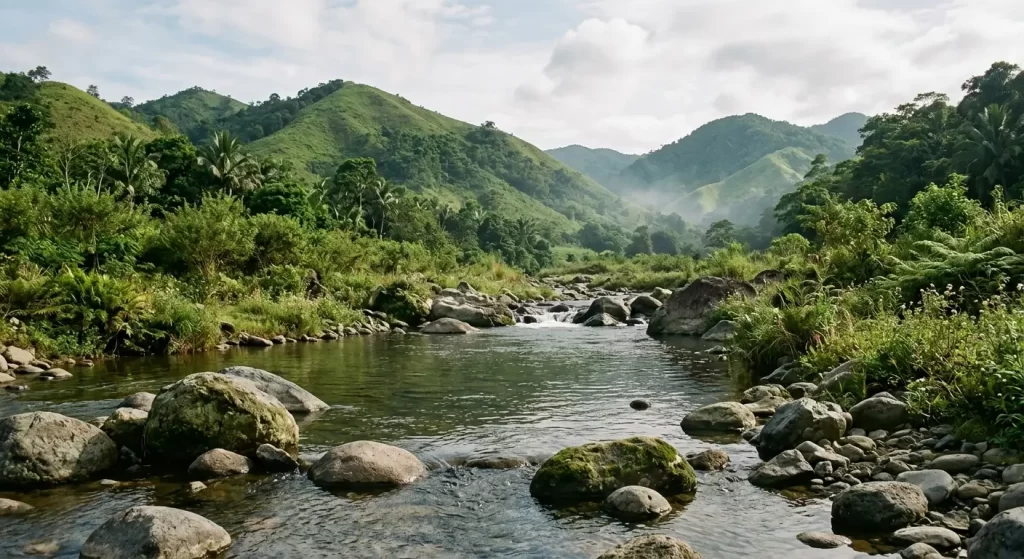
The Sacobia watershed, New Clark City’s primary water source, is central to the concern: environmental advocates, including Kalikasan People’s Network for the Environment, have pointed to signs of strain in the watershed dating back to 2020 — meaning any added industrial demand would be layered onto a water source some groups already consider stressed.
HOW THE GOVERNMENT HAS RESPONDED
Two government bodies have taken the lead in addressing water concerns publicly:
The National Water Resources Board (NWRB) issued a direct statement through Executive Director Sevilla D. David Jr., confirming that available water resources within the project area are sufficient to meet the project’s total demand without affecting local supply. The NWRB explicitly framed the commitment as prioritizing surrounding communities’ water needs “at any stage of implementation and operation.”
BCDA, for its part, has outlined a power and water sourcing strategy designed to avoid straining the public grid or competing with residential supply — including a planned 500-megawatt solar farm within New Clark City developed with Saudi firm Aqua Power, alongside a 1.2-gigawatt liquefied natural gas plant currently under study with an American firm, and evaluation of wind, geothermal, and other power arrangements with Korean and Japanese partners. Water plans reportedly include advanced zero-liquid-discharge (ZLD) recycling systems intended to reduce net freshwater draw.
BCDA has also pointed out that the proposed Pax Silica footprint — about 1,620 hectares — represents only 4.6% of the 35,300-hectare Clark Freeport and Special Economic Zone, and sits within areas already designated for development under New Clark City’s existing master plan, a framing meant to counter the impression that the project represents an entirely new or unplanned land and resource claim.
WHAT CRITICS SAY THE GOVERNMENT HASN’T ANSWERED
Agham, the scientists’ advocacy group, has pushed back on regulatory assurances specifically, rather than accepting the “sufficient supply” framing at face value. Spokesperson Giovanni Tapang has questioned whether rainwater harvesting — one of the methods reportedly under consideration — can reliably meet the project’s water demand across all seasons, and has noted that BCDA has yet to publicly detail how wastewater generated by mineral processing on-site would be treated and disposed of.
That distinction matters: much of the public reassurance so far has focused on whether there’s enough water going in, while critics are asking a related but separate question — what happens to water (and other byproducts) coming out, particularly given that semiconductor and mineral processing can generate hazardous wastewater if not properly managed.
This connects directly to the land-use question covered in our companion piece: Land, Displacement, and Pax Silica: Tracking Community Concerns Online — since much of the infrastructure needed to meet Pax Silica’s power and water demands (solar farms alone could require over 20,000 hectares) extends well beyond the core 1,620-hectare site.
WHAT’S STILL UNRESOLVED
- Which water demand figure is accurate — reporting varies between roughly 130 million liters/day and an annualized figure implying closer to 107 million liters/day, and no single reconciled number has been consistently used across coverage.
- Whether reservoir capacity will keep pace — the Inquirer analysis specifically flags a potential seasonal deficit even under currently proposed reservoir capacity.
- Wastewater treatment and disposal — a specific gap Agham has flagged that hasn’t yet been addressed in BCDA’s public communications, as of this writing.
- Whether alternative water sources (rainwater harvesting, ZLD recycling) can reliably scale to meet demand year-round, rather than only in favorable conditions.
❓ FAQS
Estimates vary by source — one Inquirer analysis puts it at roughly 130 million liters a day, while a separate environmental review cites 39 billion liters annually (an average of about 107 million liters a day). Both figures come from credible reporting but haven’t been fully reconciled.
Yes — Malacañang’s press office confirmed it sought clarification from the National Water Resources Board specifically because of concerns spreading on social media, and the NWRB publicly stated local water sources are sufficient.
It’s New Clark City’s primary water source, and environmental groups say it has shown signs of strain since 2020 — a key reason water security is one of the more urgent concerns raised about the project.
Partially. BCDA has outlined dedicated water and power sourcing plans (solar, LNG, ZLD recycling) meant to avoid straining public supply, but critics say specific technical questions — particularly around wastewater from mineral processing — remain unanswered.
This is a living article — we’ll continue updating it as NWRB, BCDA, and advocacy groups release further data or statements.
🔍 Continue exploring our Pax Silica coverage: Pax Silica Explained: The Philippines’ AI Industrial Hub · Pax Silica Timeline: From Announcement to Public Debate · Land, Displacement, and Pax Silica: Tracking Community Concerns Online · Pax Silica’s Philippine Debate Has Moved From Technology Promise to a Test of Public Trust
SOURCES
- Capstone-Intel, CAPSTONE SIGMA Research Brief: Pax Silica’s Philippine Debate Has Moved From Technology Promise to a Test of Public Trust (PDF), August 2026 — primary source for all post/engagement figures cited above.
- Philippine Daily Inquirer, “Pax Silica brings promise – but at what cost?”.
- Philippine News Agency, “Gov’t assures safeguards in proposed Pax Silica project”, July 2026.
- BusinessMirror, “Local water source enough to supply Pax Silica operation – water board”.
- BusinessWorld / Inquirer, “Pax Silica plan draws calls for deeper scientific, environmental review”.
- Rappler, “Pax Silica: BCDA’s claims and the counterarguments”.
- Manila Bulletin, “Pax Silica, explained”, July 2026.
- Philippine Information Agency, “BCDA clarifies misconceptions on Pax Silica project in New Clark City”.
- Philippine Daily Inquirer, “Myths vs facts: BCDA allays fears on controversial Pax Silica project”.
- Capstone-Intel, “Pax Silica’s Philippine Debate Has Moved From Technology Promise to a Test of Public Trust”, August 2026.