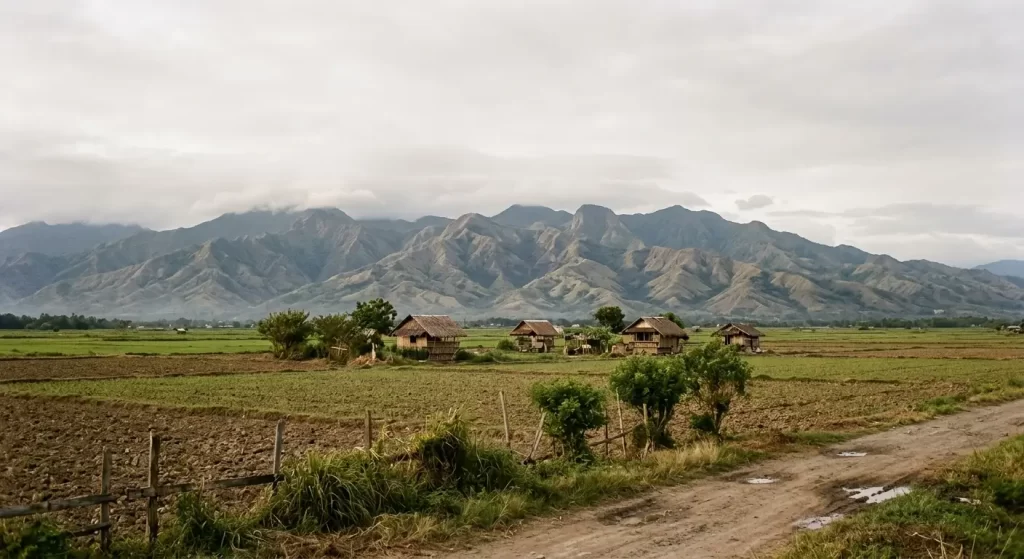
Advocacy groups say as many as 20,000 residents — including Aeta communities who’ve lived on the land for generations — and 15,000 farmers could be displaced by the proposed Pax Silica hub in New Clark City. BCDA disputes the scale of that claim. Here’s what’s actually been said, by whom, and what remains unresolved.
New to Pax Silica? Start with our explainer on what the AI industrial hub actually is before diving into this specific thread.
QUICK SUMMARY
| Proposed site | ~1,620 hectares (4,000 acres), New Clark City, Capas, Tarlac |
| Disputed displacement estimate | Up to 20,000 residents (including Aeta/Indigenous communities) and 15,000 farmers, per advocacy groups |
| BCDA’s position | Disputes displacement claims; says 15,000 hectares within Clark Freeport are already allocated to Indigenous Peoples |
| Confirmed affected barangays | O’Donnell, Aranguren, and Santa Lucia, Capas, Tarlac (per BCDA’s initial Project Affected Persons list) |
| Key legal question | Whether investors can lease land for up to 99 years under Republic Act 12252 |
| Groups raising concerns | Kalikasan People’s Network for the Environment, Unyon ng mga Manggagawa sa Agrikultura (UMA), Kilusang Magbubukid ng Pilipinas (KMP), Agham (Advocates of Science and Technology for the People) |
WHAT ADVOCACY GROUPS ARE SAYING
Several organizations have publicly raised concerns since the Pax Silica site was formally proposed in mid-2026:
Kalikasan People’s Network for the Environment has been among the most vocal, citing estimates — also reported by the South China Morning Post — that roughly 20,000 Indigenous people and 15,000 farmers could be displaced by the New Clark City project. The group’s national coordinator, Cathleen De Guzman, has focused specifically on the Aeta community’s decades-long struggle for formal recognition of their ancestral domain, arguing that the lack of documented land titles has historically been used to deny the community’s presence on land it has occupied for generations. Kalikasan has also flagged concerns about the Sacobia watershed — New Clark City’s main water source — which the group says has shown signs of drying up since 2020.
Unyon ng mga Manggagawa sa Agrikultura (UMA), an agricultural workers’ group, publicly opposed the country’s participation in Pax Silica in late July, warning that the planned “economic security zone” could accelerate land conversion across Central Luzon, suppress rural wages, and threaten both food security and environmental conditions for nearby communities.
Kilusang Magbubukid ng Pilipinas (KMP), a farmers’ movement, was sharply critical of the government’s decision to join the coalition, framing it as a move that would intensify land and resource extraction in rural areas.
Agham, a scientists’ advocacy group, has taken a more technical line of criticism — arguing that BCDA has presented an incomplete picture of the project’s potential impacts. The group has pointed to BCDA’s own initial list of Project Affected Persons, which identifies residents of barangays O’Donnell, Aranguren, and Santa Lucia in Capas, Tarlac as directly impacted by the development.
The Makabayan bloc in the House of Representatives has also filed a resolution related to the project, reflecting the concerns extending into formal legislative channels.
WHAT BCDA AND GOVERNMENT OFFICIALS ARE SAYING
The Bases Conversion and Development Authority, which administers the New Clark City site, has pushed back on the scale and framing of displacement claims. In a statement addressing what it called public misconceptions, BCDA — through Department of Trade and Industry Undersecretary Ceferino Rodolfo — has emphasized that Pax Silica is a voluntary, shared-interest framework, and has disputed claims that the project would house a massive data center, cause significant environmental impact, or displace communities at the scale advocacy groups describe.
On the Indigenous displacement question specifically, BCDA has stated that the proposed Pax Silica site itself will not displace Indigenous communities, pointing to roughly 15,000 hectares within the broader Clark Freeport Zone that the agency says have already been allocated separately for Indigenous Peoples.
BCDA President and CEO Joshua Bingcang has also confirmed the project is exploring long-term land arrangements — potentially allowing foreign investors to lease land for up to 99 years under Republic Act 12252 — which he has framed as a way for government to retain long-term revenue (BCDA has estimated roughly ₱60 billion in lease income over 25 years) rather than an outright transfer of land. Critics, however, have specifically flagged the 99-year lease provision as a land-grabbing risk given its length.
THE LAND-USE MATH THAT’S DRAWING SCRUTINY
Beyond the core 1,600–1,620 hectare footprint, a separate line of criticism has focused on the land Pax Silica’s supporting infrastructure would require. According to figures reported by BusinessWorld and Inquirer, fully powering and supplying water to the site could require:
- 3 gigawatts of power and 39 billion liters of water annually at full build-out
- More than 20,000 hectares of land for solar farms alone to meet that power demand — an area more than 12 times the size of the core Pax Silica site itself
- 390 to 780 hectares for water reservoirs, on top of planned zero-liquid-discharge recycling systems
Because current energy plans reportedly rely on a mix of solar and imported liquefied natural gas (LNG), critics argue the full resource footprint — and the land needed to support it — extends well beyond the officially cited 1,600-hectare lease, with potential knock-on effects for agricultural land and food security in surrounding areas.
This resource-use angle is covered in more depth in our companion piece: Pax Silica and Water Security: What the Facebook Conversation Reveals.
HISTORICAL CONTEXT: THIS ISN’T A NEW QUESTION
Displacement concerns around New Clark City predate Pax Silica by several years. When the broader 9,450-hectare New Clark City metropolis was first being developed, BCDA faced similar questions about the impact on local farmers and Aeta tribespeople living within the project area. At the time, BCDA maintained that no ancestral domains had been formally declared across the development area, and framed farmers and Indigenous groups as intended beneficiaries of the new city rather than parties at risk of displacement. That same underlying disagreement — over whether the absence of formal land titles means a community has no claim to the land — is now resurfacing in the Pax Silica debate, with Kalikasan explicitly invoking it as a central issue.
WHAT’S STILL UNRESOLVED
Reading across all sides, a few genuine open questions remain rather than settled facts:
- The scale of displacement — advocacy estimates (20,000 residents, 15,000 farmers) and BCDA’s confirmed Project Affected Persons list (three specific barangays) represent very different scopes, and no fully reconciled, independently verified figure has been published.
- Ancestral domain status — whether the Aeta community’s historical presence constitutes a legal claim in the absence of formally declared ancestral domain, a dispute with roots going back to the original New Clark City development.
- The 99-year lease provision — whether long-term leases under RA 12252 function as intended (retaining government ownership while generating revenue) or create practical land-grabbing risk, as critics contend.
- Full-buildout land and resource requirements — how the site’s actual footprint, once power and water infrastructure are included, compares to the officially cited 1,600 hectares.
❓ FAQS
Advocacy groups cite estimates of up to 20,000 residents (including Aeta communities) and 15,000 farmers. BCDA disputes displacement at that scale and has published a Project Affected Persons list naming three specific barangays in Capas, Tarlac.
BCDA has acknowledged specific project-affected residents in barangays O’Donnell, Aranguren, and Santa Lucia, but disputes broader claims of mass displacement, particularly regarding Indigenous communities.
BCDA has confirmed foreign investors may be offered land leases of up to 99 years under Republic Act 12252. Critics say the length of these leases raises land-grabbing concerns; BCDA frames it as a revenue-generating arrangement that keeps land under government ownership.
Kalikasan People’s Network for the Environment, Unyon ng mga Manggagawa sa Agrikultura (UMA), Kilusang Magbubukid ng Pilipinas (KMP), and the scientists’ group Agham, among others.
No — similar concerns were raised when the broader New Clark City metropolis was first developed, well before Pax Silica existed.
This is a living article — we’ll continue updating it as BCDA, advocacy groups, and affected communities release further statements or data.
🔍 Continue exploring our Pax Silica coverage: Pax Silica Explained: The Philippines’ AI Industrial Hub · Pax Silica Timeline: From Announcement to Public Debate · Pax Silica and Water Security: What the Facebook Conversation Reveals · Pax Silica’s Philippine Debate Has Moved From Technology Promise to a Test of Public Trust