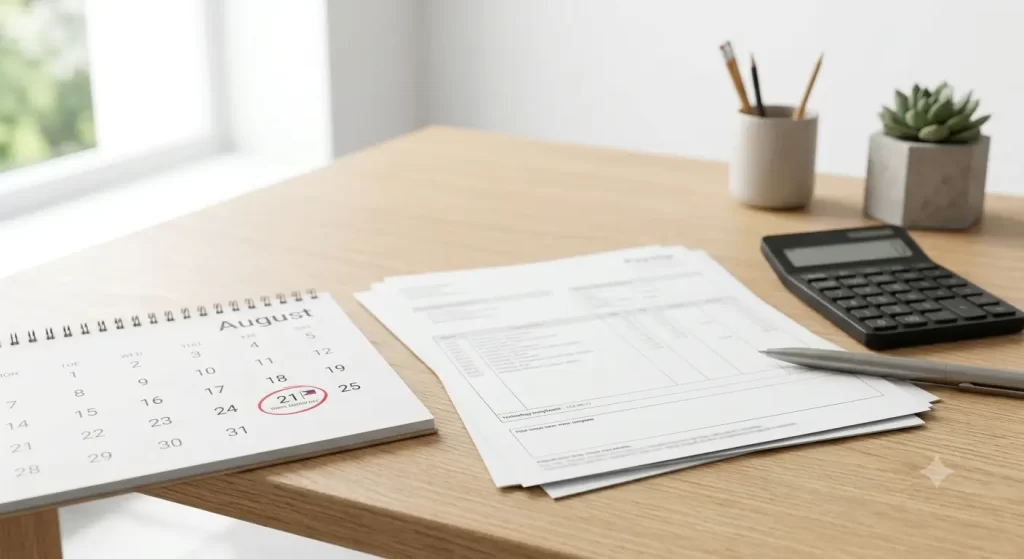
August 21, 2026 is a special non-working holiday — not a regular one. That distinction changes how your pay is computed if you’re required to report to work. Here’s the exact breakdown, straight from DOLE’s holiday pay rules, with sample computations.
If your employer needs you in on August 21, you’re not just working a normal Friday. Special non-working holidays carry their own pay premiums under Philippine labor law — and knowing the numbers means you can double-check your payslip instead of just trusting it.
New to this cluster? Start with Walang Pasok: Is August 21, 2026 a Holiday in the Philippines? for the full context on the holiday itself.
FIRST: CONFIRM THE HOLIDAY TYPE
Ninoy Aquino Day is classified as a special non-working holiday, established under Republic Act No. 9256 — not a regular holiday like Independence Day or Labor Day. This matters because the two categories follow completely different pay rules under the Labor Code and DOLE’s yearly labor advisories.
| Holiday Type | Pay If You Don’t Work | Pay If You Work |
|---|---|---|
| Regular Holiday | 100% of daily wage | 200% of daily wage |
| Special Non-Working Holiday | No pay (“no work, no pay”), unless company policy states otherwise | 130% of daily wage |
Ninoy Aquino Day falls in the second row.
THE PAY RULES, BROKEN DOWN
Here’s what DOLE’s standard formula provides for special non-working holidays like August 21:
- You don’t report to work: No pay applies, following the “no work, no pay” principle — unless your company policy, employment contract, or CBA grants pay anyway.
- You work up to 8 hours: You receive 130% of your basic daily wage (your regular wage plus an additional 30%).
- The holiday also falls on your scheduled rest day, and you work: You receive 150% of your basic daily wage (your regular wage plus an additional 50%).
- You render overtime beyond 8 hours: You receive an additional 30% of your hourly rate on the holiday, on top of whichever holiday rate above already applies.
SAMPLE COMPUTATIONS
Assuming a basic daily wage of ₱610 (illustrative example — use your actual daily rate):
Scenario 1 — You work a normal 8-hour shift on August 21 (not your rest day): ₱610 × 130% = ₱793.00 for the day
Scenario 2 — August 21 also happens to be your rest day, and you work: ₱610 × 150% = ₱915.00 for the day
Scenario 3 — You work 8 hours plus 2 hours overtime (not your rest day):
- Base holiday pay: ₱610 × 130% = ₱793.00
- Hourly rate on holiday: ₱793.00 ÷ 8 = ₱99.13
- Overtime pay (2 hrs): ₱99.13 × 130% × 2 = ₱257.73
- Total: ₱1,050.73
Always compute using your actual basic daily wage — these are illustrative only.
IF YOU DON’T WORK
Because Ninoy Aquino Day is a special (not regular) non-working holiday, the default rule is straightforward: no work, no pay. You are not entitled to holiday pay simply for the day falling on the calendar, unless:
- Your company has a favorable policy providing holiday pay regardless of attendance,
- Your collective bargaining agreement (CBA) specifies otherwise, or
- Your employment contract includes holiday pay as a standard benefit.
Daily-wage and hourly employees are the most affected by this rule, since monthly-paid employees’ salaries are often structured to already account for non-working days.
WHO’S COVERED
DOLE’s holiday pay rules generally apply to rank-and-file employees in the private sector. Some categories are excluded or handled differently, including:
- Government employees (covered by separate Civil Service Commission rules)
- Managerial employees and officers, in many cases
- Field personnel whose hours can’t be determined with reasonable certainty
- Employees of retail and service establishments with fewer than 10 regular workers, in some circumstances
If you’re unsure which category applies to you, your HR department or the nearest DOLE regional office can confirm.
FAQS
Special non-working holiday — this is the classification that determines the pay rules above.
Not by default. “No work, no pay” applies unless your company policy says otherwise.
130% of your basic daily wage for the first 8 hours, or 150% if it also falls on your rest day.
Government employees follow Civil Service Commission rules, which may differ slightly from private-sector DOLE guidelines.
You can file a complaint or inquiry with your nearest DOLE regional or field office.
THE BOTTOM LINE
Special non-working holiday pay isn’t automatic like it is on regular holidays — but if you do work on August 21, you’re entitled to a clear, specific premium. Know the numbers, check your payslip, and don’t hesitate to raise it with HR if something doesn’t add up.
Continue exploring our Ninoy Aquino Day coverage: Walang Pasok: Is August 21, 2026 a Holiday in the Philippines? · Malacañang Confirms: Ninoy Aquino Day 2026 Is a Special Non-Working Holiday · August 2026’s Double Long Weekend: Where to Go and When
This is a living article — we’ll update it if DOLE releases a specific 2026 labor advisory with updated computation guidance or exemptions.
SOURCES / FOOTNOTES
- National Today, “Ninoy Aquino Day — August 21, 2026”.
- Office Holidays, “Ninoy Aquino Day in Philippines in 2026”.
- Wikipedia, “Ninoy Aquino Day”.
- Light of Love PH, “Is Ninoy Aquino Day a Regular Holiday? Here’s What Every Filipino Should Know”, July 2026.
Note: Sample computations follow the standard DOLE formula for special non-working holidays under the Labor Code. Confirm against DOLE’s official 2026 labor advisory once released, as this article will be updated to reflect it.